Rethinking Flow States: How Simple Rituals Prepare You for Deep, Productive Work
I recently finished reading The Art of Impossible: A Peak Performance Primer by Steven Kotler. The book is full of neuroscience, practical tools, and research on what allows people to operate at their best. Kotler explores motivation, grit, goal setting, creativity, and mastery, but one theme sits at the centre of everything. That theme is “flow.”
Flow is the mental state where you are completely absorbed in a meaningful challenge. Time falls away. Distractions fade. Doubt quiets down. Your brain locks onto what you are doing with a combination of focus, clarity, and ease. Kotler describes flow as the brain’s optimal performance mode. When you are in flow, your cognitive resources line up in the right direction. Your attention narrows, pattern recognition increases, and ideas emerge with more speed and fewer barriers.
Anyone who has experienced flow knows it is unmistakable. The challenge for most people is that flow does not appear on command. You cannot force yourself into it by wanting it. You need the right conditions, the right preparation, and the right type of mental friction to lean against. You also need to know what derails it.
Kotler lays out a sequence of steps and preconditions that increase the probability of entering flow. Many of the examples he shares come from extreme sports. Big wave surfers, downhill mountain bikers, backcountry skiers, and wingsuit pilots all have an easier time getting into flow because their activities demand high levels of focus and present immediate consequences for drifting attention. If a surfer loses focus for one second, they wipe out. If a wingsuit pilot gets distracted, the results can be fatal. The level of challenge is so high that the brain’s survival machinery snaps into the moment.
But how on earth does that relate to me? I’ve never been one to seek out that sort of adrenaline rush. Those who know me know that I’d rather be at the base of the ski hill making cinnamon buns for my friends when they get back than launching myself down an icy mountain. And that’s exactly it… I get my entry into flow from other methods, and baking is one of them.
Most of us do not spend our days performing gravity-defying sports. We are not chasing 80-foot waves or jumping off cliffs in fabric suits. Or in my case, even downhill skiing… growing up in the prairies I did lots of cross country skiing as a kid, and I was that person who would take my skis off to walk down the tiny hills we have here.
If you’re like me, you spend many of your days in knowledge work, leadership, science, writing, or entrepreneurship. The stakes are still high, but the relationship between focus and consequence is less direct. If you lose focus while reviewing a report, you will not fall off a mountain (but perhaps down an internet rabbithole). The feedback loop is slower. The challenge is subtle. And the distractions are everywhere. In my opinion, this makes it even more challenging to achieve – and stay in – flow. (Yes, I wrote that, I used em-dashes before AI existed).
That is why I struggled to translate Kotler’s examples into my own life. I understood the general neuroscience and the theory, and I knew I often experienced flow. However, I was having a hard time finding what my own path into flow was so that I could use his lessons and insights to my advantage.
Then it clicked. Not while reading. Not while working. Not while thinking about peak performance. It clicked while baking sourdough.
The Unexpected Path to Flow
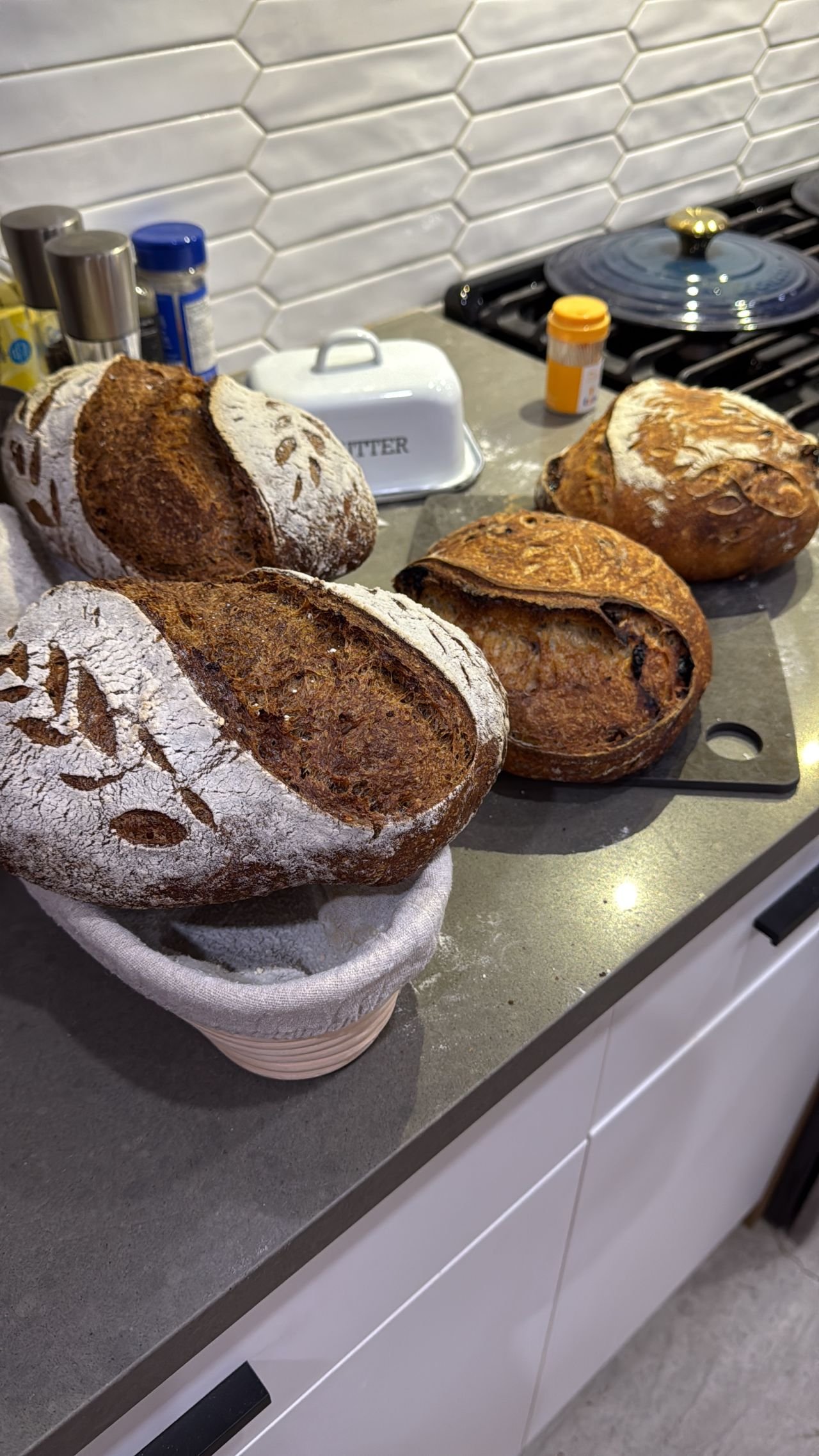
Baking has always been something I enjoy. I make sourdough several times a week. It is a ritual that has become part of the rhythm of my life, especially during busy or chaotic periods, I always make time to make bread. But I never thought of it as anything more than a hobby or a way to decompress. It was only after finishing Kotler’s book that I recognised what was actually happening. On especially taxing weeks, I’d often make more bread and give it away, and friends would say “how could you find time?”, my answer was “I couldn’t not”.
While baking itself doesn’t create the flow, the act of preparing the dough drops me into the state change that makes flow more probable in my upcoming chosen activity.
Not the full flow state itself. But the preparation for it. Baking is what Kotler would call a “deep embodiment trigger,” and it happens to be one of the steps on the pathway to flow. Kotler has a formal “flow cycle,” and preparation is the first stage. During preparation, the brain moves out of busywork, noise, and scattered attention, and toward a narrower, calmer mental field. You cannot jump into flow from distraction. You need a runway.
Baking bread is that runway for me.
Why Baking Works as a Flow Trigger
Baking bread works for me because it removes the barriers that prevent flow. I should provide context here that I grew up baking bread, it’s something I do without a recipe in front of me, without strict guidelines, it’s something I do by feel and instinct. When I bake, I stop multitasking. I stop rushing. My devices are not within reach. I am not scrolling or checking emails. I am not switching tabs, answering messages, or jumping between tasks. My attention narrows to a few simple actions.
Mix. Fold. Rest. Observe.
I am engaged with my senses. The dough’s texture changes in my hands through the stretches and folds. I am not thinking about a hundred things. I am thinking about one, but it is mostly subconscious. This shift in attention does something important. It displaces the mental noise that prevents me from doing deep creative work. It clears the runway, freeing my mind to think about bigger things. The things that only come to the surface when your mind is quiet.
When I start to mix a batch of sourdough, I can feel my mind change gears. My internal pace slows. My mind opens up and I think deeper about bigger ideas. The transition is also physical, I relax and find rhythm.
And once I finish prepping that batch of dough, I am ready to begin writing, planning, or tackling harder cognitive tasks while it goes through a 6-12 hour bulk fermentation (and I continue to monitor and enjoy its progress). The shift is consistent enough that I now recognize it as a deliberate part of my process, and I start many of my mornings by mixing a batch of dough.
What Kotler Might Say About This
Kotler discusses “deep embodiment triggers,” which are flow triggers that require full sensory involvement. Activities like dancing, playing music, rock climbing, or gardening qualify because they root the brain in the present. Baking fits this category. It is a hands-on, sensory-rich activity that forces you into the moment.
Moreover, baking also reduces cognitive load. It gives my executive function a break. It quiets the analytical parts of my brain, which creates space for creativity to emerge when I sit down to write.
One thing Kotler makes clear is that flow does not appear unless the challenge is slightly ahead of your current skill level. The sweet spot is narrow, about four percent harder than what feels comfortable. Too easy and the brain gets bored. Too hard and it tips into stress. That balance explains why my baking itself is not the flow state. The dough is not the challenge. It is the activity that clears enough cognitive space so I can take on the real challenge that follows: writing, solving technical problems, or mapping scenarios where the stakes and complexity sit in that challenge-skills sweet spot. Baking prepares the runway. The deeper work is the takeoff.
In other words, baking is not just a break. It is preparation.
What Flow Looks Like for Me
Flow for me usually appears in two areas.
The first is writing. When I am in flow while writing, ideas connect faster. Arguments sharpen. Sentences form without friction. The structure shows up naturally. I can write for hours without noticing the time passing. I typically do this with pen and paper, or on my new remarkable tablet, to avoid alerts and prevent myself from slipping into an editing mindset that I get on a laptop.
The second is problem-solving in scientific, technical, or strategic work. When I am in flow during this type of work, I can hold multiple variables in my mind. I can map different scenarios, test assumptions, and identify patterns or outliers. The work feels clean and fast.
What I had not fully appreciated until recently is that I have inadvertently built rituals into my life that shift my brain into the right state.
Flow is Personal
The mistake many people make when reading about peak performance is assuming the examples must match their life. If Kotler talks about extreme athletes, entrepreneurs think they need to simulate cliff-jumping levels of danger to get results. Scientists think they need adrenaline to focus (in fairness, a good technical debate does get my adrenaline going!). Leaders think they need high pressure to perform.
But the real question is much simpler.
What reliably removes distractions, engages your senses, and shifts your brain into a state where deeper thinking is possible?
For some people, it is running. For others, it is playing an instrument, woodworking (I once spent nearly a week sanding a rocking chair), gardening (anyone else love weeding!?), walking, drawing, meditation, or even cleaning (not me, but hey, I know some weirdos out there who like to clean ;) ). The specific activity does not matter. What matters is that it works for you to prepare your brain for the deeper work that follows.
The more we understand about how our own brains transition into flow, the more consistently we can reproduce it.
The Role of Rituals in Peak Performance
Peak performance is not about heroic bursts of effort. It is about consistency. It is about setting the stage for your brain to perform at its best in a sustainable way. That means treating rituals not as indulgences, but as part of the process.
We tend to overvalue intensity and undervalue preparation. Flow is not created by grit alone. It is created by reducing friction.
Every peak performer Kotler studies, whether an athlete, artist, scientist, executive, or entrepreneur, has rituals. They prepare their environment, they reduce distractions, and they prime their mind and body to engage.
Baking is simply one of my rituals. It creates the mental space I need to begin the deeper work.
What This Means for You
If you are reading this and wondering how to build your own flow triggers, here are the questions I would start with.
What activity reliably grounds you?
What removes distractions and gets you away from reactive work?
What helps you transition from scattered attention to focused attention?
What engages your senses or your body in a way that quiets your mind?
What helps you start creative or deep work with more ease?
Your answers do not need to be impressive. They do not need to be difficult. They do not need to resemble anyone else’s habits.
Your flow ritual only needs to work for you.
The Unexpected Bonus of Sharing Bread
I bake far more sourdough than I can eat. That is not intentional. It is a side effect of how often I use baking as a transition ritual. The upside of this is simple. When I have extra loaves, I share them. My close friends know that the more sourdough I’m gifting, the more productive I’m likely to be in my other cognitive areas, and they take the opportunity to dig into those things with me. Try to find out your friends’ flow triggers and how you can help encourage them to do more of it (it’s a win-win for my friends with bread, ha!).
Final Thoughts
Flow is not a mystical state reserved for surfers and cliff divers. It is something your brain is wired to do. But it needs the right environment. It needs preparation. And it needs rituals that make the transition feel natural instead of forced.
For me, baking is not just about the bread. It is about the mental shift it creates for me. It is a doorway into a deeper, calmer, more focused version of myself. And once I walk through that door, the creative work becomes easier.
You may already have a ritual like this without realizing it. Or you may need to experiment to find one. But once you discover the activity that clears your mind and sets the stage for focused work, you can use it intentionally instead of accidentally.
Flow is not an accident. It is a practice, and we have the tools in our everyday rituals.